

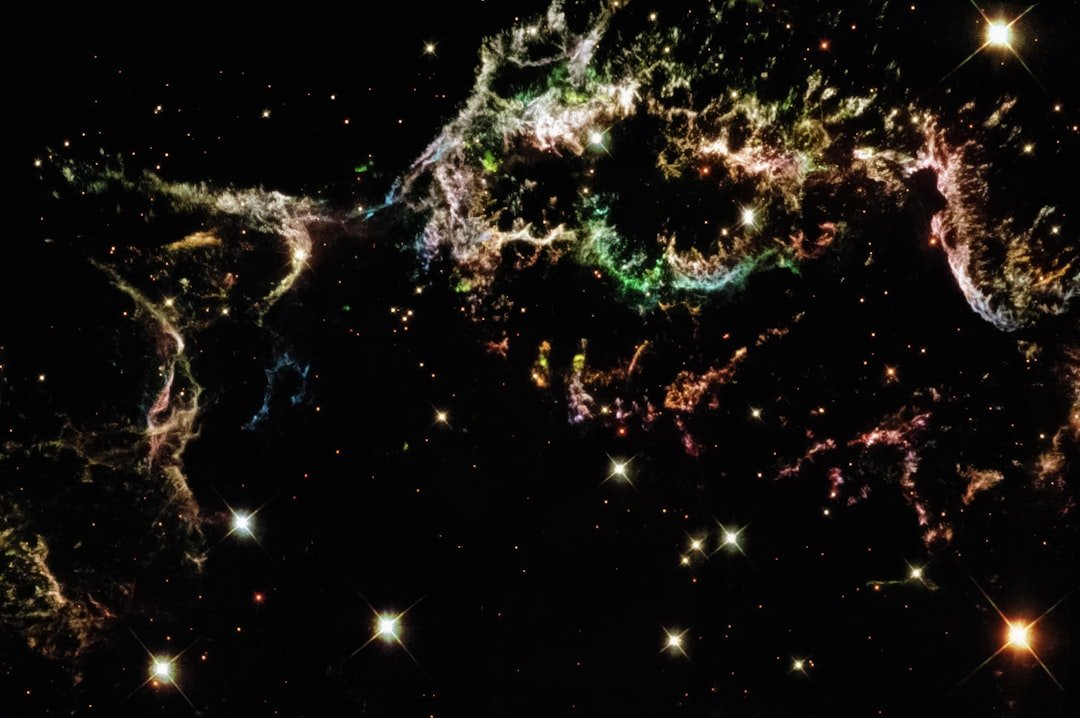
What the study found
Carbon–oxygen (C–O) shell mergers are the core-collapse supernova models that best match the observed elemental ratios in Cassiopeia A (Cas A). The study also finds that the 44 Ti (a radioactive isotope of titanium) expected from these mergers is below current NuSTAR and COS I detection limits and is likely mostly inside the reverse shock.
Why the authors say this matters
The authors say these elemental ratios can be used as diagnostics for C–O shell mergers in core-collapse supernovae. They conclude that this helps interpret the observed X-ray and infrared properties of supernova remnants and assess where 44 Ti is located relative to the reverse shock.
What the researchers tested
The researchers studied 44 Ti production in core-collapse supernovae and compared yields from eight sets of models with observations of Cas A. They focused on elemental ratios involving silicon, sulfur, calcium, argon, and neon, with special attention to the argon-to-neon ratio as a sign of C–O shell mergers.
What worked and what didn't
C–O shell merger models consistently matched the Cas A X-ray and infrared observations better than nonmerger models. These merger models produced high Ar/Ne ratios, at or above about 0.1, because 20 Ne was depleted and 36 Ar and 38 Ar were produced; nonmerger cases gave lower ratios. The expected 44 Ti from the merger component may be up to about 20%–30% of the total 44 Ti, but it is expected to lie outside the reverse shock and to remain below present detection limits; the authors note it might be detectable with proposed missions like ASCENT. For the supernova remnant of 1987A, the authors say a dominant C–O merger origin for the observed 44 Ti is unlikely based on the redshift of its 44 Ti line.
What to keep in mind
The abstract does not give detailed limitations beyond the model sets and observations compared. The 44 Ti detectability statement is based on the models considered, and the 1987A conclusion is limited to the evidence described in the abstract.
Key points
- C–O shell merger models best matched the elemental ratios observed in Cassiopeia A.
- High argon-to-neon ratios, at or above about 0.1, were highlighted as a diagnostic of C–O shell mergers.
- The merger component may produce up to about 20%–30% of the total 44 Ti in Cas A.
- The expected 44 Ti from the merger is below current NuSTAR and COS I detection limits and likely outside the reverse shock.
- The authors say a dominant C–O merger origin for 44 Ti in 1987A is unlikely.
Disclosure
- Research title:
- C-O shell mergers best match Cas A element ratios
- Image credit:
- Photo by NASA Hubble Space Telescope on Unsplash
Get the weekly research newsletter
Stay current with peer-reviewed research without reading academic papers — one filtered digest, every Friday.